Sunday, January 3, 2010

Great Expectations 16


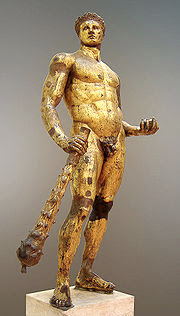
  • "Joe was a fair man, with curls of flaxen, hair on each side of his smooth face ... He was mild, good-natured, sweet-tempered, easy-going, foolish, dear fellow -- a sort of Hercules in strength, and also in weakness." (p. 6)
In Greek mythology, Hercules was a divine hero, known especially for his strength, courage, and determination. Ultimately, Hercules was forced to complete Twelve Labors because he killed his wife and children. Aside from committing this violent act, Hercules' weaknesses also included being lustful and gluttonous. Dickens alludes to Hercules to describe Joe's character. Joe possesses strengths such as patience, unconditional love, and faithfulness. However, here Pip indicates Joe's weaknesses being that he is defenseless and vulnerable when it comes to dealing with his wife, Pip's cruel sister.

Work Cited:
"Fast Facts on Hercules." About.com. Web. 3 Jan. 2010. http://gogreece.about.com/cs/mythology/a/mythhercules.htm.

Photo Credit:
Photograph. WIkipedia. Web. 3 Jan. 2010. http://en.wikipedia.org/wiki/File:0064MC.jpg.

Video Credit:
"The Twelve Labors of Hercules." Youtube. Web. 3 Jan. 2010. http://www.youtube.com/watch?v=oGMG-t3t98s

Great Expectations 15

  • "In short, I was always full of fears for the rash man who was in hiding ... But I thought with dread that it was flowing towards Magwitch, and that any black mark on its surface might be his pursuers, going swiftly, silently, and surely to take him." (p. 382)
Upon meeting Magwitch and understanding his situation more in depth, Pip develops very contratdicting feelings towards him. Originally, Pip has a fear of Magwitch because he is unsure of his intentions. However, Pip now also has a fear for Magwitch and his safety. It takes him awhile to realize this, but Pip has uncovered his genuine appreciation of Magwitch's loyalty and friendship, and can't help being concerned with what the convicts future holds. Dickens is able to exemplify the theme of realizing human connections are more important than social status through Magwitch and Pip's relationship.

Great Expectations 14


  • "Oh, dear good Joe, whom I was so ready to leave and so unthankful to, I see you again ... Oh, dear good faithful tender Joe, I feel the loving tremble of your hand upon my arm, as solemnly this day as if it had been the rustle of an angel's wing" (p. 142)
One of the most important themes that Dickens expresses in Great Expectations is overcoming the fact that social status is not a standard for happiness and the importance of treating loved ones with respect. By the end of the novel, Pip realizes that he is extremely unthankful to Joe, his most loyal and supportive family member. Even though Pip's huge dreams and emotions clash, he put aside his main concerns of appearance and social status, and is able to appreciate the continuous love and friendship Joe has for him.

Photo Credit:
Photograph. Life Vesting. Web. 3 Jan. 2010. http://www.lifevesting.com/blog/wp-content/uploads/2009/01/loving-father.jpg.

Great Expectations 13


  • "Not another word had I heard to enlighten me on the subject of my expectations, and my twenty-third birthday was a week gone." (p. 314)
In a few cases, Pip references his 'great expectations' and what he feels needs to be accomplished or maintained in order to be successful. Readers are able to understand the title of the story as we learn more about Pip's personality and other characters. Charles Dickens intends for the title to indicate Pip's ultimate desire for an improved status and romantic advancement with Estella. Another interpretation of the title may be Pip's expectation of wealth once he becomes a gentleman or all the things that is assumed to accompany life of high importance. Not only do other characters put pressure on Pip to thrive, but ultimately he has even higher expectations for himself, and dreams he wishes to conquer. Though this title, Dickens is able to express the major issue in the novel: Pip's high expectation to find happiness through becoming a gentleman ... yet, he counts too much on what he doesn't have/wants to have in the future and values too little, which he does already have.

Photo Credit:
Great Expectations. Photograph. Blondie Rocket. Web. 3 Jan. 2010. http://blondierocket.files.wordpress.com/2008/08/great-expectations1.jpg.

Great Expectations 12


  • "It was a dark night, though the full moon rose as I left the enclosed lands, and passed out upon the marshes ... There was a melancholy wind, and the marshes were very dismal." (p. 425)
Throughout the entire novel, Dickens uses vivid imagery to set a dramatic tone. Keying in on the weather, particularly elements such as darkness and mist, Dickens creates a powerful setting for the mystery and action about to take place. Readers know that whenever mist is present something dangerous is about to happen. Obviously mist and darkness hinder one's vision, therefore, Dickens uses it to forewarn readers of Pip's unsureness and potential risk. Mist is present when Pip meets the convict in the cemetery, when Orlick attempts to kill Pip, and even in the re-written ending, mist appears as Pip meets Estella. Rewriting the ending including the eerie-mist-effect could indicate Pip's potential dangerous future.

Work Cited:
"Great Expectations." Shmoop. Web. 3 Jan. 2010. http://www.shmoop.com/great-expectations/symbolism-imagery.html.

Photo Credit:
Trees in the Mist. Photograph. Google Image. Web. 3 Jan. 2010. http://gallery.photo.net/photo/1313809-lg.jpg.

Great Expectations 11


  • "The man who was pulling a lock of hair in the middle of his forehead, like the Bull in Cock Robin pulling the bell-rope." (p. 166)
Dickens alludes to the poem "Cock Robin" as Pip compares the bull in the poem to the man tugging at a lock of hair. In this poem, the death of Cock Robin is declared:

Who killed Cock Robin? I, said the sparrow With my bow and arrow I killed Cock Robin.

Numerous animals gather to prepare for Cock Robin's funeral when the Bull announces:

Who'll toll the bell? I, said the bull, Because I can pull, I'll toll the bell.

The image of the man pulling at a lock of his hair instantly reminds Pip of the Bull in this childish poem.


Work Cited:
"Notes on the Novel." Discovering Dickens. Web. 3 Jan. 2010. http://dickens.stanford.edu/archive/great/great_issue7gloss.htm.

Photo Credit:
Who Killed Cock Robin? Photograph. Mama Lisa's World. Web. 3 Jan. 2010. http://images.google.com/imgres?imgurl=http://www.mamalisa.com/images/mother_goose/cockrobin_gut.gif&imgrefurl=http://www.mamalisa.com.

Great Expectations 10

  • "They were all in excellent spirits on the road home, and sang "O Lady Fair!" (p. 105)
At this point in the novel, Pip confirms his apprenticeship with Joe, yet is disappointed and angry with this decision. Pip's sister and Joe take him out to celebrate with Pumblechook and Mr. Wopsle. On their way home, Mr. Wopsle begins to recite Collins's Ode and sing the song, 'O Lady Fair' by Thomas Moore. Charles Dickens alludes to this particular song as it was very popular for a late night walk. The lyrics read:

"Oh, Lady fair! where art thou roaming? The sun has sunk, the night is coming. Stranger, I go o'er moor and mountain, To tell my beads at Agnes' fountain. And who is the man, with his white locks flowing? O Lady Fair! where is he going? A wand'ring Pilgrim, weak, I falter, To tell my beads at Agnes' alter."

The poems' tone and many questions asked reveal the curiosity of the speaker; much like Pip describes Mr. Wopsle as always wanting to know others "personal affairs." Still regarding Mr. Wopsle, Pip directly answers the lines in the poem by saying "he was the man with the white locks flowing, and that he was upon the whole and weakest pilgrim going." (p. 105) Pip's emphasis on "he" suggest that he was mocking Mr. Wopsle. His overall tone in this excerpt appears critical and annoyed with Mr. Wopsle's curiosity.

Work Cited:
"Great Expectations." Google Books. Web. 3 Jan. 2010. http://books.google.com/books?id=d55huNQmSGgC&pg=PA491&lpg=PA491&dq=o+lady+fair!+-+great+expectations.